I went to two different high schools. At the second one, I fell into the wrong crowd. They had a room to hang out in, off of the library where they could talk, plan hijinks, discuss teachers & students...a free-form and welcome release from the strictures of student-teacher experiences. Study hall in the library was a boring affair, and some of the students would encourage me to hang out and play chess in their room. Their "teacher", Harvey Kimble, was okay with that, and even let me officially join them my senior year.
It was a talented and gifted group. When I say "teacher", he had been a teacher and had switched over to TAG. It was a great experience for me. I think teachers are amazing...and Harvey blew them all away. If there's a word above teacher, assume I used it for him. He was compassionate, funny, challenging, and had this love of enjoying things that he shared with us.
One of the experiences that he mandated for us, was serving breakfast to some inner city children in Des Moines, Iowa. It was early in the morning down by Drake University, I think. Pre-school, kindergarten, maybe some first graders. We helped serve breakfast, did a craft area...there was even a game area. Kimble told me with a smile - after the breakfast portion, I needed to go help out there.
They had checkers, and the kids were excited to play against me - despite my encouragement to play each other. See, they had a plan. They had never lost against the TAG students, and they were looking to take me down too. It was fun - they made up rules on how the game REALLY played. Of course, they didn't tell me those rules until they used them on me.
Halfway to my end, I started using their tricks in return. I could only use the rules they had introduced to me - and my opponent tried to revoke some of those rules in the process. Thankfully the horde of young spectators insisted on fairness. I did end up breaking their streak of wins, but they were pretty happy about it. I was adopted by them, as I had been adopted by the TAG group.
A couple of weeks and several garage sales later, I showed up again for breakfast. This time, I shared my game with them. My father and brothers (and even my sister Martha for a little while) played chess with me. These kids were smart enough to make up their own rules for games, they could learn chess. And they did. It offered complexity, tricks...a bigger game sandbox to play in.
These kids had a tough life then, and I don't imagine it got easier. Kids that young would be used to run drugs. An older teen would take the money, the kid would deliver the drugs. If a police officer stopped the 5 year-old, they wouldn't get good information. It was too big for me and it was bad for the kids - one of those "facts of life" moments that killed me a little inside every time I thought about it.
One of the kids came up to me in a later session. He didn't really feel like his dad loved him, or wanted anything to do with him. This wasn't an uncommon theme - you listen, demonstrate compassion, try to help them cope. He shared with his dad that he had learned chess at the breakfast club! His dad was surprised and doubtful, but got out a board and they played. At the end of the game, his dad apparently had tears in his eyes, and they had bonded. The kid had a happy smile and tears in his eyes when he told me.
This is why I dig board games. Creativity, social glue, critical thinking, it's all there. There are studies out there that discuss how games can spur critical thinking skills, catching up those kids who fall between the cracks - I can believe that.
And a special thanks for Harvey Kimble and the breakfast club for the memories.
Thursday, December 5, 2013

Sunday, October 13, 2013
Macao, the Continued Revival
My initial review of Macao was about 3 years ago. I wasn't sure that I liked it - the unknown deck of buildings and people, the fickleness of the dice...since then, we've played dozens of games.
And I still don't know if I like the game. How's that for strange?
It's still what I consider a "light" game. It has issues if players bog down themselves/others/the game with analysis. There's no clean method of choosing cubes, except for taking the unintuitive step outside the mechanics to write down the cubes you take. Players who are delaying can change their decisions based on early choosers, and early choosers look awkward when they realize a better arrangement...mostly when other people have started making choices.
The randomness of the dice can be mitigated by the 6 "dark tokens" aka wild cards. There are buildings and people that can sometimes offer some flexibility, but it's not common and/or not easy to build....er..."activate".
The buildings/people stack is random, and has a huge effect on the game - if you are in the position to draft the card you need. And if you aren't going earlier in the turn order, you risk other people co-opting your strategy, drafting it "because they have the cubes for it", or in a more competitive game....defensively drafting it so you (or others) don't get it. If you defensively draft too often, it'll burn you. Depending on your group and number of players, it can vary a lot.
I wouldn't mind doing a variant where each player gets to secretly view 10 cards at the start of the game, and discard 2. You still wouldn't know *when* it shows up, as far as which turn - you might not be in first, it might show up in the final turn, etc. Definitely adding some skill and longer strategy to the game...a lot of Macao is short-term thinking.
Overall, it gets play because it's quick to teach, with elegant rules. And someday I'll be able to decide if it's good. ;)
And I still don't know if I like the game. How's that for strange?
It's still what I consider a "light" game. It has issues if players bog down themselves/others/the game with analysis. There's no clean method of choosing cubes, except for taking the unintuitive step outside the mechanics to write down the cubes you take. Players who are delaying can change their decisions based on early choosers, and early choosers look awkward when they realize a better arrangement...mostly when other people have started making choices.
The randomness of the dice can be mitigated by the 6 "dark tokens" aka wild cards. There are buildings and people that can sometimes offer some flexibility, but it's not common and/or not easy to build....er..."activate".
The buildings/people stack is random, and has a huge effect on the game - if you are in the position to draft the card you need. And if you aren't going earlier in the turn order, you risk other people co-opting your strategy, drafting it "because they have the cubes for it", or in a more competitive game....defensively drafting it so you (or others) don't get it. If you defensively draft too often, it'll burn you. Depending on your group and number of players, it can vary a lot.
I wouldn't mind doing a variant where each player gets to secretly view 10 cards at the start of the game, and discard 2. You still wouldn't know *when* it shows up, as far as which turn - you might not be in first, it might show up in the final turn, etc. Definitely adding some skill and longer strategy to the game...a lot of Macao is short-term thinking.
Overall, it gets play because it's quick to teach, with elegant rules. And someday I'll be able to decide if it's good. ;)
Tuesday, September 3, 2013
Krosmaster Arena review
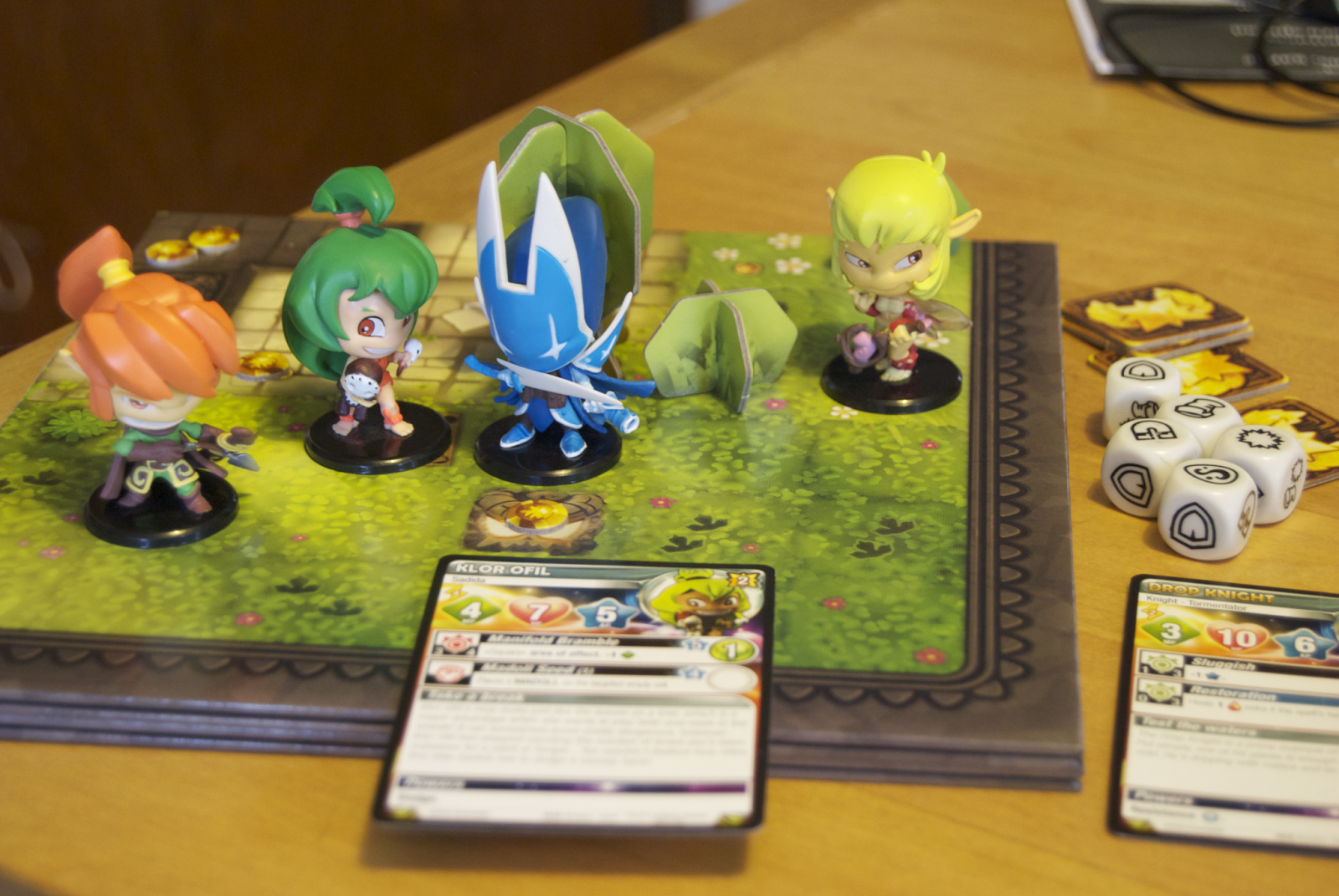 | |
| Some figures on a quarter of the board |
Krosmaster Arena is based on a French anime series, and the game was imported into the US market by Japanime, first through this Kickstarter. You can find an electronic version of the game here.
It's a light wargame, best with 2 or 4 players. Each turn, your 4 or 2 figures spend their movement points to get around the board, and their action points to power spells and attacks on the figure's card. While technically you win by the opponent not having any Golden Galleons (GG), this is primarily done by knocking out your opponent's figures.
Component Quality
The figures are really great. Well painted, interesting, dynamic. A couple of them will probably need to be touched up with some super glue. The game comes with a double-sided map, Demonic Reward tokens, some summoned creature tokens, cardboard trees/bushes/boxes, and custom six-sided dice. There are an assortment of chits to track wounds, lost/gained actions and movement points, as well as the coins (kamas).
Rulebook
The rulebook takes the approach of teaching the game using mini-tutorials. After 6 or so tutorials, you reach the main rulebook - it's good, but I wish the structure was a little more clear. GG didn't seem that important until we played the electronic version.
Gameplay
Overall, it's pretty fast. You can break up your movement between actions, making it very flexible. The six-sided dice drive the random elements - how much bonus damage did you get? how much did you block? Did you roll enough boots to escape the magnets that they rolled to stop you?
Tension
Your turn starts off rolling 2 dice for 'tension'. If you get matching dice, each player loses a GG. (If a team has no GG left, they lose.) Then, assign the dice to the same or different characters that you control - a starburst lets you roll two dice when rolling damage with that character. Likewise, the other 3 options are powering up your ability to block damage, escape, or lock.
Actions
You move your characters around, spending action points to pick up the coins scattered around the board, spending action points to buy Demonic Rewards at shops, and hopefully attacking the other figures.
Battles
Very straightforward - your average attack value is 1-2, with a specific range. You roll an extra 1 or 2 dice to add damage, they roll 1 or 2 dice to get shields, their figure takes some damage. A 1 point attack is probably going to eat up about half of the attacking figure's action points. If you knock out an opposing figure, you get GG from that player equal to the figure's level...usually about 3.
Duration
The game takes about 45-60 minutes to play, depending how players go. Defensive, ducking around, stealing health...it can take another half hour. I've played the electronic game in about 20-30 minutes.
Replay Value
The base game comes with 8 figures, exactly enough to play 4 players (or the 2-player game with 4 figures each)...meaning you'll see the same characters every game. Maybe some different pairings, different tactics, almost certainly some different Demonic Rewards...but...the characters drive the game. Getting a booster of 4 figures expands the choices and game play a lot.
Online Component
When you buy a booster/base game or win a promo figure, it comes with a code to play it online. It might even be faster to learn the game on the computer, and then play in real life.
Deal Breakers
The price point and availability is probably the biggest killer for this game. $28 for a booster of 4 figures seems pretty crazy. $80 for the base game is probably fair, as long as you have a lesser need for a strong replay value out of the box.
Overall
The game itself is fun. Players get to move their cool figures around the board, beating up other figures...rolling dice, taking cover - a light wargame. We'll probably have this in regular rotation, as well as fitting in some electronic battles with each other.
Thursday, August 22, 2013
Lords of Waterdeep, Scoundrels of Skullport review
PAX Prime is coming up in the next week, and there's a board game tournament put on by Wizards of the Coast, for the new Lords of Waterdeep expansion. We played last year, and I made it into the elimination rounds on the virtue of having won a game. I won my semi-final game, maybe two...making it into the finals.
I didn't end up winning. I did get an LED-hat with Lolth on it, and a prize pick from the game table. This year, I'm not sure we'll put as much time into winning a spot - the expansion much more variable in what matters. How much more variable? Read on!
[If you read BGG, it's there too. This is just everything in one place.]
I picked up a copy of the expansion at a local game store on Sunday - Green Lake Games in Seattle. I had read the rulebook online and had a good idea what we were getting into...
Lords of Waterdeep as a base game is solid. The theme and mechanics are complementary, the flavor and art definitely sell Waterdeep without the hangup of "I don't know how to play D&D." The rules and mechanics had very little "I can't figure out how this works from reading the card."
The main question for my friends and I: how much does adding the expansion(s) change the game? The answer? Quite a bit.
Components Overview:
Poor. How about cards that a slightly different size from the base game? Slightly different shading on the back? Or the card back not matching the orientation of front of the card? This is Wizards of the Coast - messing up cards shouldn't even be a concern. It's cool they continued the innovative packaging from the base game...except the agents need to be placed head down to fit nicely. Oh well.
It's nice they added a 6th player, but it hasn't been a problem in the past - 5 was the playable limit. It makes some Intrigue cards that much better, but there's so much downtime between actions at that point, you can't guess what might be left for your next one.
Set-up:
You can play Scoundrels as both mini-expansions with the main game (taking out some random main game intrigue cards, quests, and buildings so Skullport & Undermountain would still show frequently). You can also play with one or the other, without taking out main game components.
They also included extra agent figures for the base game - this is necessary if you play the recommended "long game" variant when playing both expansions. (Otherwise, lots of empty action spaces.)
Skullport Overview:
Essentially, every building, quest and intrigue card from Skullport is going to have corruption involved somehow. The mechanics for corruption adds a heavier layer to the game - you'll find yourself constantly trying to figure out if it's worth doing the bigger action for a little bit of corruption. Getting rid of corruption is fairly common, with some putting it on an action space, removing it from the game, or putting it back on the corruption track.
Corruption caution: If you need to take corruption and there isn't any left, it's -10 points immediately. And there are intrigue cards that can give corruption, without you doing anything.
Undermountain Overview:
Lots of interesting buildings, quests, and intrigue cards. Powerful combos & some 40-point quests. There is a lot of "take some stuff, and put stuff on other action spaces" which can lead to some complex wrangling of actions...so you can get those bonus materials that might otherwise go to other players.
Skullport vs. Undermountain:
I liked Undermountain a lot more than Skullport. If you want new mechanics and hard-to-guess "best action" questions, Undermountain got most of them. Skullport is limited because nearly everything is based on corruption - put lots of cubes/rewards on a card, then add a corruption marker or two.
Flow Overview:
You remember earlier, how I mentioned how the gameplay in base Lords of Waterdeep flowed mostly naturally, with little rules questions? One of the challenges in adding *more* to a game, is keeping the game elegant and clear of questions, but still making the expansion interesting.
The expansions add mechanics without answering core timing issues. (One of my gripes with Quarriors, but onward!) For example, there's a plot quest that says you get the owner benefit from your buildings when you go to your own building. Let's say you go to a building that lets you play 3 Intrigue cards, the owner benefit says you draw an Intrigue card. When do you draw it? Or the plot quest that lets you draw and play an Intrigue card when you play one or more Intrigue cards - can you do the draw-and-play in the middle of resolving an action? [EDIT: Owner benefit is last. Resolve the 3 Intrigue cards, then draw-and-play for the plot quest.]
I'm hoping they address some basic core timing issues in a FAQ, so that my friends and I don't have to house-rule constantly, as well as teaching house-rules to friends coming over. (Game designers & developers, keep timing in mind when you're putting out the expansions - *you* have a plan on how things work innately, but maybe a page in the expansion rulebook talking about timing issues is much better than a FAQ after the fact.)
Flow, Part 2:
Expansions are a tricky beast. You need to add new things, but leave enough of the core. In the games we've played, there's just so much going on. You might have 4 plot quests, each doing their own crazy thing. The new rewards can be a lot different (build all three buildings for free!) which just adds to the distractions.
So adding new things is both necessary, and sometimes a downer. The randomness "swingy bits" is a lot more prevalent with Scoundrels. You can't reasonably guess what an intrigue card will do, what buildings you might see, or what quests will pop up. In the base game, you might have a reasonable idea on what could happen. Playing one mini-expansion makes it not likely, and two next to impossible.
Lords of Waterdeep went from a strategic game where you might plan ahead for next turn, to a tactics game where you min-max your current action and maybe your next action.
Overall, LoW needed an expansion. Most of the mechanics were pretty vanilla in the base game after the first several plays - the economy of cubes was straightforward as far as acquiring them and using for quests. We'll play the expansions, even with the rules issues and the wild swings of what's now possible...but there's some sadness at least on my part.
One last thing - the Inevitable Betrayal promo? It's in the expansion, for those who didn't get it before. (Woo!)
I didn't end up winning. I did get an LED-hat with Lolth on it, and a prize pick from the game table. This year, I'm not sure we'll put as much time into winning a spot - the expansion much more variable in what matters. How much more variable? Read on!
[If you read BGG, it's there too. This is just everything in one place.]
I picked up a copy of the expansion at a local game store on Sunday - Green Lake Games in Seattle. I had read the rulebook online and had a good idea what we were getting into...
Lords of Waterdeep as a base game is solid. The theme and mechanics are complementary, the flavor and art definitely sell Waterdeep without the hangup of "I don't know how to play D&D." The rules and mechanics had very little "I can't figure out how this works from reading the card."
The main question for my friends and I: how much does adding the expansion(s) change the game? The answer? Quite a bit.
Components Overview:
Poor. How about cards that a slightly different size from the base game? Slightly different shading on the back? Or the card back not matching the orientation of front of the card? This is Wizards of the Coast - messing up cards shouldn't even be a concern. It's cool they continued the innovative packaging from the base game...except the agents need to be placed head down to fit nicely. Oh well.
It's nice they added a 6th player, but it hasn't been a problem in the past - 5 was the playable limit. It makes some Intrigue cards that much better, but there's so much downtime between actions at that point, you can't guess what might be left for your next one.
Set-up:
You can play Scoundrels as both mini-expansions with the main game (taking out some random main game intrigue cards, quests, and buildings so Skullport & Undermountain would still show frequently). You can also play with one or the other, without taking out main game components.
They also included extra agent figures for the base game - this is necessary if you play the recommended "long game" variant when playing both expansions. (Otherwise, lots of empty action spaces.)
Skullport Overview:
Essentially, every building, quest and intrigue card from Skullport is going to have corruption involved somehow. The mechanics for corruption adds a heavier layer to the game - you'll find yourself constantly trying to figure out if it's worth doing the bigger action for a little bit of corruption. Getting rid of corruption is fairly common, with some putting it on an action space, removing it from the game, or putting it back on the corruption track.
Corruption caution: If you need to take corruption and there isn't any left, it's -10 points immediately. And there are intrigue cards that can give corruption, without you doing anything.
Undermountain Overview:
Lots of interesting buildings, quests, and intrigue cards. Powerful combos & some 40-point quests. There is a lot of "take some stuff, and put stuff on other action spaces" which can lead to some complex wrangling of actions...so you can get those bonus materials that might otherwise go to other players.
Skullport vs. Undermountain:
I liked Undermountain a lot more than Skullport. If you want new mechanics and hard-to-guess "best action" questions, Undermountain got most of them. Skullport is limited because nearly everything is based on corruption - put lots of cubes/rewards on a card, then add a corruption marker or two.
Flow Overview:
You remember earlier, how I mentioned how the gameplay in base Lords of Waterdeep flowed mostly naturally, with little rules questions? One of the challenges in adding *more* to a game, is keeping the game elegant and clear of questions, but still making the expansion interesting.
The expansions add mechanics without answering core timing issues. (One of my gripes with Quarriors, but onward!) For example, there's a plot quest that says you get the owner benefit from your buildings when you go to your own building. Let's say you go to a building that lets you play 3 Intrigue cards, the owner benefit says you draw an Intrigue card. When do you draw it? Or the plot quest that lets you draw and play an Intrigue card when you play one or more Intrigue cards - can you do the draw-and-play in the middle of resolving an action? [EDIT: Owner benefit is last. Resolve the 3 Intrigue cards, then draw-and-play for the plot quest.]
I'm hoping they address some basic core timing issues in a FAQ, so that my friends and I don't have to house-rule constantly, as well as teaching house-rules to friends coming over. (Game designers & developers, keep timing in mind when you're putting out the expansions - *you* have a plan on how things work innately, but maybe a page in the expansion rulebook talking about timing issues is much better than a FAQ after the fact.)
Flow, Part 2:
Expansions are a tricky beast. You need to add new things, but leave enough of the core. In the games we've played, there's just so much going on. You might have 4 plot quests, each doing their own crazy thing. The new rewards can be a lot different (build all three buildings for free!) which just adds to the distractions.
So adding new things is both necessary, and sometimes a downer. The randomness "swingy bits" is a lot more prevalent with Scoundrels. You can't reasonably guess what an intrigue card will do, what buildings you might see, or what quests will pop up. In the base game, you might have a reasonable idea on what could happen. Playing one mini-expansion makes it not likely, and two next to impossible.
Lords of Waterdeep went from a strategic game where you might plan ahead for next turn, to a tactics game where you min-max your current action and maybe your next action.
Overall, LoW needed an expansion. Most of the mechanics were pretty vanilla in the base game after the first several plays - the economy of cubes was straightforward as far as acquiring them and using for quests. We'll play the expansions, even with the rules issues and the wild swings of what's now possible...but there's some sadness at least on my part.
One last thing - the Inevitable Betrayal promo? It's in the expansion, for those who didn't get it before. (Woo!)
Sunday, July 28, 2013
Castle Dice review
It's a light dice game, produced through Kickstarter. Seemed fun enough that I'd play it again several times, but not deep enough that I need a copy if a friend has it. (Comparable to the base 7 Wonders game in difficulty and amount of time.)
Players have 7 turns to get victory points from building Castle cards and turning in animal sets for random chance cards. Every turn, players take certain dice based on the turn, and add several of their choice. (Players make this choice based on Castle/Village cards in their hands, and what they hope to build with the resources they get that round.)
Village cards increase or adjust your production. Castle cards are primarily VP, sometimes with a minor game effect. You might guess that Castle cards are more expensive to get out.
Once everyone rolls their dice, they take any dice-killing barbarians out to add to the players' own turf. In turn order, players then draft one die at a time, adding the appropriate resource to their bank. (3 wood from the wood die, increases your wood stock by 3, then discard the die for the round.) The 4 different animals let you break the rules in small ways, or you can turn in a set of 4 (different) to get a chance card. After all of the dice have been drafted, players build their cards from their hand - and any leftover resources might be raided by your barbarians (a brown barbarian would only raid for 1 wood).
The game goes fairly quickly. The player interaction is limited to counter-drafting - very indirect. The chance cards seemed like a fairly light return, but then again, the random draws from Castle and Village decks make it difficult to have a consistent hand of building what you want to build.
It would be interesting to see what would have happened if players could choose which specific "Village" card that wanted to draw. For example, if you wanted to build soldiers that turn, you could draw soldiers. (Same for farmers, merchants, workers.) Heck, maybe even be able to choose to draw "wall" cards vs. random Castle cards.
The game, as-is, is very light on strategy. I think it'd be fun to play with kids who are getting into board games, as the reading is light and there is a luck factor that isn't overwhelming.
Players have 7 turns to get victory points from building Castle cards and turning in animal sets for random chance cards. Every turn, players take certain dice based on the turn, and add several of their choice. (Players make this choice based on Castle/Village cards in their hands, and what they hope to build with the resources they get that round.)
Village cards increase or adjust your production. Castle cards are primarily VP, sometimes with a minor game effect. You might guess that Castle cards are more expensive to get out.
Once everyone rolls their dice, they take any dice-killing barbarians out to add to the players' own turf. In turn order, players then draft one die at a time, adding the appropriate resource to their bank. (3 wood from the wood die, increases your wood stock by 3, then discard the die for the round.) The 4 different animals let you break the rules in small ways, or you can turn in a set of 4 (different) to get a chance card. After all of the dice have been drafted, players build their cards from their hand - and any leftover resources might be raided by your barbarians (a brown barbarian would only raid for 1 wood).
The game goes fairly quickly. The player interaction is limited to counter-drafting - very indirect. The chance cards seemed like a fairly light return, but then again, the random draws from Castle and Village decks make it difficult to have a consistent hand of building what you want to build.
It would be interesting to see what would have happened if players could choose which specific "Village" card that wanted to draw. For example, if you wanted to build soldiers that turn, you could draw soldiers. (Same for farmers, merchants, workers.) Heck, maybe even be able to choose to draw "wall" cards vs. random Castle cards.
The game, as-is, is very light on strategy. I think it'd be fun to play with kids who are getting into board games, as the reading is light and there is a luck factor that isn't overwhelming.
Thursday, July 11, 2013
Ad Astra Review
I finally fit in a game of Ad Astra. I saw it on a friend's game table once, and thought - it has exploration, trading...great! This is for me...but maybe I should play it before buying another space game.
We played a 4-player game - it can handle five. The core of the game is playing your action cards into order. Maybe you want your exploration card put early in the turn order, or a production card placed at the end of the round. This is the actual game, not the giant space board that covers most of the table.
You start with a factory in the home system, and a spaceship in "deep space" (one space away from every system). After everyone has placed action cards into the order hopper (12 spaces, 4 players - we each put in 3 cards), start by revealing the card in the first position.
Ah, Red played Explore a small yellow system or explore a large red system. Red gets to move one of their spaceships to one of those systems, or jump a spaceship from any system to deep space. If you move into an unexplored system, you get to choose which facedown planet you take. Everyone else gets the same movement option, then Red can move more ships.
The next card might be a Production card by Blue, where the Blue player chooses which mode of the card happens - produce resource A or resource B. Everyone gets that resource, if they have spaceships, colonies, or factories on that resource from a planet.
The action card types are Explore, Production, Build, Trade, and Score. (Build lets everyone build one thing, based on their resource cards in hand, and the person who put it in can build whatever; Trade lets that player and that player only to trade with other players, or 2-for-1 with the bank.)
Score cards are modal as well - choose to score all colonies/factories or spaceships. Whoever gets the most points from a score card also gets 3 bonus points. Each player has the same three different Score cards...and you only get them back after you've used all of them (preventing a player from playing the same Score card every turn).
The Explore part is weak. Trade is weak. Build is unexciting. Production becomes a question of if you've overlapped with other players or if you specialized in a resource. (Some or all/nothing.) Score cards are a reflection of what you've done on the board (again, some points or all/nothing).
They have a light alien/chance card effect, but the alien cards were pretty weak. Ad Astra looks really awesome, but the action takes place elsewhere. I'll probably end up playing it again, but probably not for several years.
We played a 4-player game - it can handle five. The core of the game is playing your action cards into order. Maybe you want your exploration card put early in the turn order, or a production card placed at the end of the round. This is the actual game, not the giant space board that covers most of the table.
You start with a factory in the home system, and a spaceship in "deep space" (one space away from every system). After everyone has placed action cards into the order hopper (12 spaces, 4 players - we each put in 3 cards), start by revealing the card in the first position.
Ah, Red played Explore a small yellow system or explore a large red system. Red gets to move one of their spaceships to one of those systems, or jump a spaceship from any system to deep space. If you move into an unexplored system, you get to choose which facedown planet you take. Everyone else gets the same movement option, then Red can move more ships.
The next card might be a Production card by Blue, where the Blue player chooses which mode of the card happens - produce resource A or resource B. Everyone gets that resource, if they have spaceships, colonies, or factories on that resource from a planet.
The action card types are Explore, Production, Build, Trade, and Score. (Build lets everyone build one thing, based on their resource cards in hand, and the person who put it in can build whatever; Trade lets that player and that player only to trade with other players, or 2-for-1 with the bank.)
Score cards are modal as well - choose to score all colonies/factories or spaceships. Whoever gets the most points from a score card also gets 3 bonus points. Each player has the same three different Score cards...and you only get them back after you've used all of them (preventing a player from playing the same Score card every turn).
The Explore part is weak. Trade is weak. Build is unexciting. Production becomes a question of if you've overlapped with other players or if you specialized in a resource. (Some or all/nothing.) Score cards are a reflection of what you've done on the board (again, some points or all/nothing).
They have a light alien/chance card effect, but the alien cards were pretty weak. Ad Astra looks really awesome, but the action takes place elsewhere. I'll probably end up playing it again, but probably not for several years.
Thursday, June 20, 2013
Eclipse Strategy Tips
The quick overview: You have 9 turns to gain the most victory points.
Your total VP at the end of the game is based on these factors:
Methods of Winning:
These are the general methods in how you gain the various VP listed above.
It is EXTREMELY important to be able to take 3 or more actions in a turn. If you spend discs to hold systems that only grant you one planet for a population cube, you will find yourself with un-upgraded ships, little ability to explore, and no economy to support taking more valuable systems from Ancient Ships. (Imagine this turn - build a dreadnought, upgrade a dreadnought, move a dreadnought, have a disc leftover to take the system...that's 4 actions.) Planned bankruptcy can free up your discs, without spending action discs to do so with Influence.
In the last few turns of the game, if most of your discs are tied up holding systems, it means you have less action discs to respond to aggressions. Consequently, if an opponent has tied up their discs, even if they are strong, they can't respond easily to your threats. Having the existing money or money income to take 5 or more actions in the final round can be very important to winning.
Exploration Combat Odds
Choke Points (Explore)
It's tempting to rely on how you explore and how you angled those hexes, to control how others can attack you. In the first two-thirds of the game, choke points will work to funnel player attacks against you into a limited number of hexes. Once the Cloaking technology or Wormhole Generator shows up (and is affordable), those choke points will become less useful...and all of those discs you spent being defensive there will not be as useful.
It can be common for games with newer players, where players only connect to each other through the Galactic Center. This usually reduces the amount of player versus player combats, as the only person who can attack or be attacked is the person controlling the center.
War & Technology
Key early technologies will carry you through the first half of the game.
"Rock-Paper-Scissors" Ship Builds
Unless you have a lot of science or upgrade actions available to repel or initiate combat against another player, your ships will typically have either be a rock, paper, or scissors build.
Final Point
Managing your discs is so extremely important it needs to be repeated. If you get down to only being able to spend two discs each turn...in 2 turns you have 4 actions, while a person with 3 discs per turn would have 6 actions - essentially a free turn compared to you.
Your total VP at the end of the game is based on these factors:
- Controlling systems (1-4 VP each, as stated on the hex)
- Reputation draws (every battle gives you a 1-4 VP chip) - each race can have 3-5 chips.
- Science tracks (if you max out a row, you get 5 VP for that row)
- Discovery tiles (2 VP, instead of being used for their power)
- Monoliths constructed by players (3 VP each, expensive and easy to target)
- Race-specific victory point goals
- The current person who has the Traitor card (think hot potato/musical chairs)
- (Expansion only) - Alliance bonus/betrayal, limited Development bonus
Methods of Winning:
These are the general methods in how you gain the various VP listed above.
- Exploring (primarily discovery tiles)
- If you explore Tier 3 hexes, they typically have less Ancient Ships (board-generated enemies), less resources, less victory points, but more likely to have discovery tiles.
- Discovery tiles can boost your economy quickly, kept as 2 VP, or get you early ship components.
- It is important to read over planned bankruptcy - at the end of each of the 9 turns, you have to pay money equal to the amount revealed by the discs you have spent. The more discs you spend on taking actions or claiming systems, the more you will have to pay at the end of the turn. If you cannot pay enough money, you reclaim discs from the board until your money income+existing money is equal to or greater than the taxes you need to pay. This can be to your benefit, to reclaim those discs you spent to take the discovery tiles. (If you have existing material or science you may use those to avoid bankruptcy, but it's not mandatory. Material and science income cannot be used.)
- War (reputation draws, discovery tiles, controlling higher VP/better economy systems)
- Early combats will get you better quality reputation draws on average. (Bigger battles give you more draws to choose one from.)
- Fighting hexes with Ancient Ships - these hexes are generally going to have better resource production, as well as VP draws, and earlier discovery tiles.
- Technology (science track VPs, and in rare cases Monoliths)
- Science gain is primarily a multiplier effect on action discs, beyond providing VP at the end.
- Ships and ship upgrades rely heavily on science purchases to wage better war.
- Economy bonuses - Advanced Economy, Advanced Labs, Advanced Mining, and Orbitals make your systems more productive, without the cost of extra discs. Advanced Robotics gives you a cheap extra disc - similar to an economy bonus, as well as giving you more flexible disc allocation.
It is EXTREMELY important to be able to take 3 or more actions in a turn. If you spend discs to hold systems that only grant you one planet for a population cube, you will find yourself with un-upgraded ships, little ability to explore, and no economy to support taking more valuable systems from Ancient Ships. (Imagine this turn - build a dreadnought, upgrade a dreadnought, move a dreadnought, have a disc leftover to take the system...that's 4 actions.) Planned bankruptcy can free up your discs, without spending action discs to do so with Influence.
In the last few turns of the game, if most of your discs are tied up holding systems, it means you have less action discs to respond to aggressions. Consequently, if an opponent has tied up their discs, even if they are strong, they can't respond easily to your threats. Having the existing money or money income to take 5 or more actions in the final round can be very important to winning.
Exploration Combat Odds
- Tier 3 hexes will have less planets to settle, a high percentage of discovery tiles, and a low percent of Ancient Ships.
- Tier 1 & Tier 2 hexes are about 50% Ancient Ships - if you see three Tier 1 hexes out there already without an Ancient Ship, you're very likely to see them on future Tier 1 explores.
Choke Points (Explore)
It's tempting to rely on how you explore and how you angled those hexes, to control how others can attack you. In the first two-thirds of the game, choke points will work to funnel player attacks against you into a limited number of hexes. Once the Cloaking technology or Wormhole Generator shows up (and is affordable), those choke points will become less useful...and all of those discs you spent being defensive there will not be as useful.
It can be common for games with newer players, where players only connect to each other through the Galactic Center. This usually reduces the amount of player versus player combats, as the only person who can attack or be attacked is the person controlling the center.
War & Technology
Key early technologies will carry you through the first half of the game.
- Improved Hull makes your ships last longer - a cruiser or dreadnought with two improved hulls are essentially immune to a single Ancient ship.
- Plasma Cannon makes Ancient Ships 1-hit kills, for the low energy cost of 2.
- Positron Computers can give you the slight speed edge, as well helping you hit more often - but still not as good as an early Improved Hull or Plasma Cannon.
- Neutron Bombs are almost mandatory for killing enemy population cubes.
- Anti-Matter Cannon does 4 damage in one hit, enough to kill most ships. In the expansion, they add a splitter, allowing the 4 damage to be spread over multiple ships.
- Plasma Missiles trump faster ships, but only in quantity - computers are mandatory!
- Star Bases often trump fast ships, and have the space allotment of a cruiser.
- Cloaking (expansion) and Wormhole Generator techs are the red flag for possible aggressive behavior, even if you buy them to stop others from getting them.
"Rock-Paper-Scissors" Ship Builds
Unless you have a lot of science or upgrade actions available to repel or initiate combat against another player, your ships will typically have either be a rock, paper, or scissors build.
- Fast ships trump armored ships (computers and good cannons mean over time, they win more often, and the opening round can wipe out the opponent's most effective ships due to speed)
- Missiles trump fast ships (missile ships require missile & computer parts to make sure they hit hard on that opening salvo, but then lack room for more armor or lasers)
- Armor+Shields trump missiles (negate missile-computers, making the only set of missiles mostly ineffective, but the armor and shields will take up most of your ship)
Final Point
Managing your discs is so extremely important it needs to be repeated. If you get down to only being able to spend two discs each turn...in 2 turns you have 4 actions, while a person with 3 discs per turn would have 6 actions - essentially a free turn compared to you.
Subscribe to:
Posts (Atom)

 Posts
Posts

