Showing posts with label review. Show all posts

Tuesday, September 3, 2013

Krosmaster Arena review

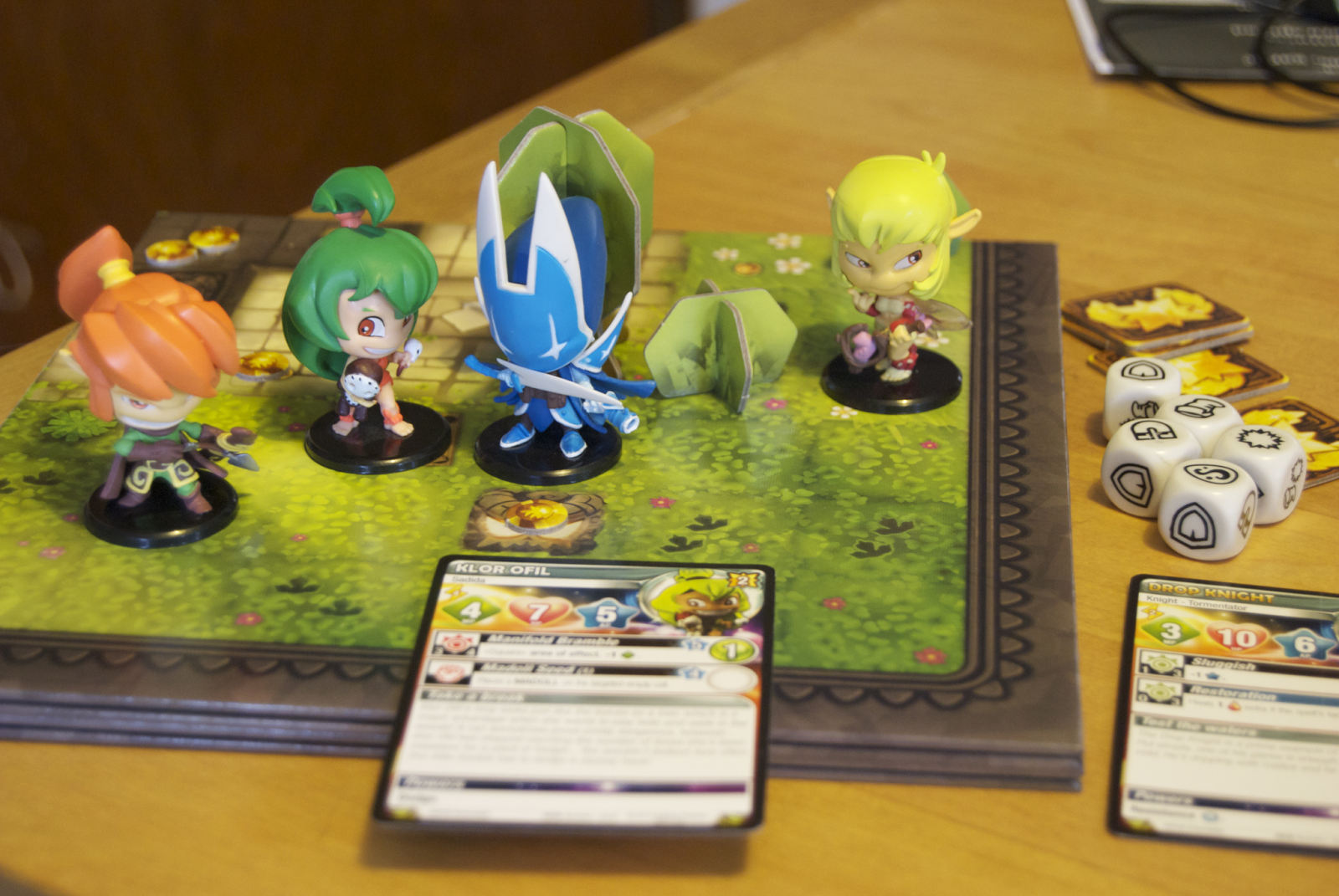
Some figures on a quarter of the board


Krosmaster Arena is based on a French anime series, and the game was imported into the US market by Japanime, first through this Kickstarter. You can find an electronic version of the game here.

It's a light wargame, best with 2 or 4 players. Each turn, your 4 or 2 figures spend their movement points to get around the board, and their action points to power spells and attacks on the figure's card. While technically you win by the opponent not having any Golden Galleons (GG), this is primarily done by knocking out your opponent's figures.


Component Quality
The figures are really great. Well painted, interesting, dynamic. A couple of them will probably need to be touched up with some super glue. The game comes with a double-sided map, Demonic Reward tokens, some summoned creature tokens, cardboard trees/bushes/boxes, and custom six-sided dice. There are an assortment of chits to track wounds, lost/gained actions and movement points, as well as the coins (kamas).

Rulebook
The rulebook takes the approach of teaching the game using mini-tutorials. After 6 or so tutorials, you reach the main rulebook - it's good, but I wish the structure was a little more clear. GG didn't seem that important until we played the electronic version.

Gameplay
Overall, it's pretty fast. You can break up your movement between actions, making it very flexible. The six-sided dice drive the random elements - how much bonus damage did you get? how much did you block? Did you roll enough boots to escape the magnets that they rolled to stop you?

Tension
Your turn starts off rolling 2 dice for 'tension'. If you get matching dice, each player loses a GG. (If a team has no GG left, they lose.) Then, assign the dice to the same or different characters that you control - a starburst lets you roll two dice when rolling damage with that character. Likewise, the other 3 options are powering up your ability to block damage, escape, or lock.

Actions
You move your characters around, spending action points to pick up the coins scattered around the board, spending action points to buy Demonic Rewards at shops, and hopefully attacking the other figures.

Battles
Very straightforward - your average attack value is 1-2, with a specific range. You roll an extra 1 or 2 dice to add damage, they roll 1 or 2 dice to get shields, their figure takes some damage. A 1 point attack is probably going to eat up about half of the attacking figure's action points. If you knock out an opposing figure, you get GG from that player equal to the figure's level...usually about 3.

Duration
The game takes about 45-60 minutes to play, depending how players go. Defensive, ducking around, stealing health...it can take another half hour. I've played the electronic game in about 20-30 minutes.

Replay Value
The base game comes with 8 figures, exactly enough to play 4 players (or the 2-player game with 4 figures each)...meaning you'll see the same characters every game. Maybe some different pairings, different tactics, almost certainly some different Demonic Rewards...but...the characters drive the game. Getting a booster of 4 figures expands the choices and game play a lot.

Online Component
When you buy a booster/base game or win a promo figure, it comes with a code to play it online. It might even be faster to learn the game on the computer, and then play in real life.

Deal Breakers
The price point and availability is probably the biggest killer for this game. $28 for a booster of 4 figures seems pretty crazy. $80 for the base game is probably fair, as long as you have a lesser need for a strong replay value out of the box.

Overall
The game itself is fun. Players get to move their cool figures around the board, beating up other figures...rolling dice, taking cover - a light wargame. We'll probably have this in regular rotation, as well as fitting in some electronic battles with each other.

Thursday, August 22, 2013

Lords of Waterdeep, Scoundrels of Skullport review

PAX Prime is coming up in the next week, and there's a board game tournament put on by Wizards of the Coast, for the new Lords of Waterdeep expansion. We played last year, and I made it into the elimination rounds on the virtue of having won a game. I won my semi-final game, maybe two...making it into the finals.

I didn't end up winning. I did get an LED-hat with Lolth on it, and a prize pick from the game table. This year, I'm not sure we'll put as much time into winning a spot - the expansion much more variable in what matters. How much more variable? Read on!

[If you read BGG, it's there too. This is just everything in one place.]


I picked up a copy of the expansion at a local game store on Sunday - Green Lake Games in Seattle. I had read the rulebook online and had a good idea what we were getting into...

Lords of Waterdeep as a base game is solid. The theme and mechanics are complementary, the flavor and art definitely sell Waterdeep without the hangup of "I don't know how to play D&D." The rules and mechanics had very little "I can't figure out how this works from reading the card."

The main question for my friends and I: how much does adding the expansion(s) change the game? The answer? Quite a bit.

Components Overview:
Poor. How about cards that a slightly different size from the base game? Slightly different shading on the back? Or the card back not matching the orientation of front of the card? This is Wizards of the Coast - messing up cards shouldn't even be a concern. It's cool they continued the innovative packaging from the base game...except the agents need to be placed head down to fit nicely. Oh well.

It's nice they added a 6th player, but it hasn't been a problem in the past - 5 was the playable limit. It makes some Intrigue cards that much better, but there's so much downtime between actions at that point, you can't guess what might be left for your next one.

Set-up:
You can play Scoundrels as both mini-expansions with the main game (taking out some random main game intrigue cards, quests, and buildings so Skullport & Undermountain would still show frequently). You can also play with one or the other, without taking out main game components.

They also included extra agent figures for the base game - this is necessary if you play the recommended "long game" variant when playing both expansions. (Otherwise, lots of empty action spaces.)

Skullport Overview:
Essentially, every building, quest and intrigue card from Skullport is going to have corruption involved somehow. The mechanics for corruption adds a heavier layer to the game - you'll find yourself constantly trying to figure out if it's worth doing the bigger action for a little bit of corruption. Getting rid of corruption is fairly common, with some putting it on an action space, removing it from the game, or putting it back on the corruption track.

Corruption caution: If you need to take corruption and there isn't any left, it's -10 points immediately. And there are intrigue cards that can give corruption, without you doing anything.

Undermountain Overview:

Lots of interesting buildings, quests, and intrigue cards. Powerful combos & some 40-point quests. There is a lot of "take some stuff, and put stuff on other action spaces" which can lead to some complex wrangling of actions...so you can get those bonus materials that might otherwise go to other players.

Skullport vs. Undermountain:
I liked Undermountain a lot more than Skullport. If you want new mechanics and hard-to-guess "best action" questions, Undermountain got most of them. Skullport is limited because nearly everything is based on corruption - put lots of cubes/rewards on a card, then add a corruption marker or two.

Flow Overview:
You remember earlier, how I mentioned how the gameplay in base Lords of Waterdeep flowed mostly naturally, with little rules questions? One of the challenges in adding *more* to a game, is keeping the game elegant and clear of questions, but still making the expansion interesting.

The expansions add mechanics without answering core timing issues. (One of my gripes with Quarriors, but onward!) For example, there's a plot quest that says you get the owner benefit from your buildings when you go to your own building. Let's say you go to a building that lets you play 3 Intrigue cards, the owner benefit says you draw an Intrigue card. When do you draw it? Or the plot quest that lets you draw and play an Intrigue card when you play one or more Intrigue cards - can you do the draw-and-play in the middle of resolving an action? [EDIT: Owner benefit is last. Resolve the 3 Intrigue cards, then draw-and-play for the plot quest.]

I'm hoping they address some basic core timing issues in a FAQ, so that my friends and I don't have to house-rule constantly, as well as teaching house-rules to friends coming over. (Game designers & developers, keep timing in mind when you're putting out the expansions - *you* have a plan on how things work innately, but maybe a page in the expansion rulebook talking about timing issues is much better than a FAQ after the fact.)

Flow, Part 2:
Expansions are a tricky beast. You need to add new things, but leave enough of the core. In the games we've played, there's just so much going on. You might have 4 plot quests, each doing their own crazy thing. The new rewards can be a lot different (build all three buildings for free!) which just adds to the distractions.

So adding new things is both necessary, and sometimes a downer. The randomness "swingy bits" is a lot more prevalent with Scoundrels. You can't reasonably guess what an intrigue card will do, what buildings you might see, or what quests will pop up. In the base game, you might have a reasonable idea on what could happen. Playing one mini-expansion makes it not likely, and two next to impossible.

Lords of Waterdeep went from a strategic game where you might plan ahead for next turn, to a tactics game where you min-max your current action and maybe your next action.

Overall, LoW needed an expansion. Most of the mechanics were pretty vanilla in the base game after the first several plays - the economy of cubes was straightforward as far as acquiring them and using for quests. We'll play the expansions, even with the rules issues and the wild swings of what's now possible...but there's some sadness at least on my part.

One last thing - the Inevitable Betrayal promo? It's in the expansion, for those who didn't get it before. (Woo!)

Sunday, July 28, 2013

Castle Dice review

It's a light dice game, produced through Kickstarter. Seemed fun enough that I'd play it again several times, but not deep enough that I need a copy if a friend has it. (Comparable to the base 7 Wonders game in difficulty and amount of time.)

Players have 7 turns to get victory points from building Castle cards and turning in animal sets for random chance cards. Every turn, players take certain dice based on the turn, and add several of their choice.  (Players make this choice based on Castle/Village cards in their hands, and what they hope to build with the resources they get that round.)

Village cards increase or adjust your production. Castle cards are primarily VP, sometimes with a minor game effect. You might guess that Castle cards are more expensive to get out.

Once everyone rolls their dice, they take any dice-killing barbarians out to add to the players' own turf. In turn order, players then draft one die at a time, adding the appropriate resource to their bank. (3 wood from the wood die, increases your wood stock by 3, then discard the die for the round.) The 4 different animals let you break the rules in small ways, or you can turn in a set of 4 (different) to get a chance card. After all of the dice have been drafted, players build their cards from their hand - and any leftover resources might be raided by your barbarians (a brown barbarian would only raid for 1 wood).

The game goes fairly quickly. The player interaction is limited to counter-drafting - very indirect. The chance cards seemed like a fairly light return, but then again, the random draws from Castle and Village decks make it difficult to have a consistent hand of building what you want to build.

It would be interesting to see what would have happened if players could choose which specific "Village" card that wanted to draw. For example, if you wanted to build soldiers that turn, you could draw soldiers. (Same for farmers, merchants, workers.) Heck, maybe even be able to choose to draw "wall" cards vs. random Castle cards.

The game, as-is, is very light on strategy. I think it'd be fun to play with kids who are getting into board games, as the reading is light and there is a luck factor that isn't overwhelming.

Thursday, July 11, 2013

Ad Astra Review

I finally fit in a game of Ad Astra. I saw it on a friend's game table once, and thought - it has exploration, trading...great! This is for me...but maybe I should play it before buying another space game.

We played a 4-player game - it can handle five. The core of the game is playing your action cards into order. Maybe you want your exploration card put early in the turn order, or a production card placed at the end of the round. This is the actual game, not the giant space board that covers most of the table.

You start with a factory in the home system, and a spaceship in "deep space" (one space away from every system). After everyone has placed action cards into the order hopper (12 spaces, 4 players - we each put in 3 cards), start by revealing the card in the first position.

Ah, Red played Explore a small yellow system or explore a large red system. Red gets to move one of their spaceships to one of those systems, or jump a spaceship from any system to deep space. If you move into an unexplored system, you get to choose which facedown planet you take. Everyone else gets the same movement option, then Red can move more ships.

The next card might be a Production card by Blue, where the Blue player chooses which mode of the card happens - produce resource A or resource B. Everyone gets that resource, if they have spaceships, colonies, or factories on that resource from a planet.

The action card types are Explore, Production, Build, Trade, and Score. (Build lets everyone build one thing, based on their resource cards in hand, and the person who put it in can build whatever; Trade lets that player and that player only to trade with other players, or 2-for-1 with the bank.)

Score cards are modal as well - choose to score all colonies/factories or spaceships. Whoever gets the most points from a score card also gets 3 bonus points. Each player has the same three different Score cards...and you only get them back after you've used all of them (preventing a player from playing the same Score card every turn).

The Explore part is weak. Trade is weak. Build is unexciting. Production becomes a question of if you've overlapped with other players or if you specialized in a resource. (Some or all/nothing.) Score cards are a reflection of what you've done on the board (again, some points or all/nothing).

They have a light alien/chance card effect, but the alien cards were pretty weak. Ad Astra looks really awesome, but the action takes place elsewhere. I'll probably end up playing it again, but probably not for several years.

Wednesday, March 27, 2013

Initial review of Vlaada Chvatil's Mage Knight

I'm hugely disappointed that Wizkids doesn't offer rules support for Quarriors - to the point where I'd even avoid purchasing other games they produce, even by a favorite designer. I've mulled over Mage Knight since it came out, but couldn't pull the trigger.

My girlfriend was aware of my "could be good, but not buying it" stance, and just bought it one day when we were hanging out at a game store. It sat on our shelf for several weeks, waiting for the right time to come and play.

It plays 1-4. Word on the street is that the rules and game are dense. I ended up doing a single-player game as a warm-up one day, watched a guy play a single-player on youtube (painful, it's not worth it!), and then played a 2-player with the girl.

The rules are dense and somewhat clunky. I like Chvatil's design for Through the Ages - elegant! Dungeon Lords, Galaxy Trucker, and Space Alert are good in different ways. Mage Knight has so many rules that are not easily intuitive, I'm sad.

** The overview **

Mage Knight is an adventuring board game, in a complex vein of Runebound. Each player has a hero, who slowly walks around fighting monsters, occasionally picking up an ally. There are different scenarios to play, but that's pretty much the focus of the game - level up, take on bigger rewards.

The engine for gameplay is your own custom deck of cards. Everyone's deck is the same except for one card. You'll be able to add more cards to your deck, pretty much at the expense of your entire turn...I think we each added 4-5 cards. Everyone has their own selection of skill level-ups, but you won't see many in a game - maybe 2.

Your starting hand each turn is 5 cards. They can have a range of ordinary things - Move, Attack, Block, Influence, and custom effects that affect other cards. Each of those ordinary effects have a number - Attack 4 is good. Attack 2 means you'll need to add extra cards to make it work. Move 2 gives you enough move into a plains hex, or explore the edge of the map. If you have enough Block, you can avoid taking wounds (that clutter your hand and deck). Influence (combined with whatever reputation you've gained) is used in towns to pick up allies, spell cards, and advanced training cards.

Each card in your hand has a second effect. You can borrow 1 energy die from the common pool to use the second/better effect. If you have other energy lying around, you could boost more than one card. Needless to say, the basic effect of each card is tough to love. (Cards in your hand can be used as Attack/Move/Block/Influence 1. Wounds cannot be used that way.)

It's really about just wandering around and killing monsters. You can attack monasteries, Mage Towers, dungeons, tombs, monster dens...they all give you some kind of bonus, with the more challenging ones giving a bigger reward.
***
That quick overview is about it. The game adds some complexity on how monsters deal damage or avoid damage, as well as rules for playing during the day vs. a turn at night. Overall, it's a lot of fiddly bits.

First - movement is cranky. You thought Runebound was awkward, with rolling dice for movement. If you want to move and attack, you better have exactly the right cards. Mostly, you'll move and then have to attack next turn, because you'll probably need Block cards too (starting hand size is 5 for awhile). Or maybe you just want to move, and none of the cards you drew have move icons - each card can be used as a Move 1...which means you spend 2 to get just one plains space. (Your movement and vision change at night, as well as some spell effects.)

Second - damage is sluggish. You need X to kill a creature - fine. But to avoid damage from a monster, you spend block value equal to or greater than their attack value...or don't spend the cards. How about managing damage? Damage absorption is messy. And what happens if combat goes awry? Your hand floods with wounds, making you unable to draw cards. You spend your next turn, or turns as needed, discarding wounds into your discard pile (so next round you'll be crippled). Amazingly punishing.

Third - it's a deck-building game. You're supposed to add more cards to make your character better, right? The basic game is 3 large turns (Day, Night, Day.) Typically when you get a card, it goes on top of your deck - you'll get it for next turn. It's hard to imagine getting any of those cards in the first day cycle, which means for the effort of buying those cards, you *might* use them twice the entire game. Assuming you don't buy them on turn 3, or buy them turn 2 and not see them in turn 3.

There are variants, which I'm sure we'll explore. And the player vs. player, which they recommend for later games...maybe I'll revisit after some more experience.